
11.4. バーダナウ注意機構
10.7 章 で機械翻訳に出会ったとき、私たちは 2 つの RNN に基づく系列変換学習のためのエンコーダ–デコーダアーキテクチャを設計した (Sutskever et al., 2014)。 具体的には、RNN エンコーダは可変長の系列を 固定形状 のコンテキスト変数へ変換する。 その後、RNN デコーダは生成されたトークンとコンテキスト変数に基づいて、出力(ターゲット)系列をトークンごとに生成する。
図 10.7.2 を思い出してほしい。ここではそれを少し詳しくしたものを (図 11.4.1) として再掲する。従来の RNN では、ソース系列に関するすべての関連情報は、エンコーダによって内部の 固定次元 の状態表現へと変換される。デコーダは、この状態そのものを、翻訳系列を生成するための完全かつ唯一の情報源として用いる。言い換えると、系列変換機構は中間状態を、入力として与えられたどのような文字列に対しても十分統計量として扱う。
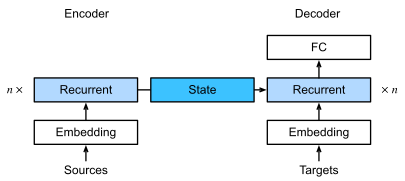
図 11.4.1 系列変換モデル。エンコーダによって生成された状態だけが、エンコーダとデコーダの間で共有される情報である。
短い系列に対してはかなり妥当だが、本や章、あるいは非常に長い文のような長い系列に対しては明らかに不可能である。結局のところ、あまり長くはないうちに、中間表現の中にソース系列の重要な情報をすべて格納するための「空間」が足りなくなる。したがって、デコーダは長く複雑な文を翻訳できなくなる。この問題に最初に直面した一人が Graves (2013) であり、彼は手書き文字を生成する RNN を設計しようとした。ソーステキストは任意の長さを取りうるため、微分可能な注意モデルを設計し、テキスト文字と、はるかに長いペン軌跡とを整列させた。この整列は一方向にのみ進む。さらに、音声認識におけるデコードアルゴリズム、たとえば隠れマルコフモデル (Rabiner and Juang, 1993) にも着想を得ている。
整列を学習するというアイデアに触発されて、Bahdanau et al. (2014) は、一方向の整列制約 なし の微分可能な注意モデルを提案した。 トークンを予測するとき、入力トークンのすべてが関連するとは限らないなら、モデルは現在の予測に関連すると見なされる入力系列の一部にだけ整列(あるいは注意)する。これを用いて、次のトークンを生成する前に現在の状態を更新する。説明だけを見るとさほど目立たないが、この バーダナウ注意機構 は、深層学習における過去10年で最も影響力のあるアイデアの一つになったと言ってよく、Transformer (Vaswani et al., 2017) や多くの関連する新しいアーキテクチャを生み出した。
from d2l import torch as d2l
import torch
from torch import nn
from d2l import mxnet as d2l
from mxnet import init, np, npx
from mxnet.gluon import rnn, nn
npx.set_np()
from d2l import jax as d2l
from flax import linen as nn
from jax import numpy as jnp
import jax
from d2l import tensorflow as d2l
import tensorflow as tf
11.4.1. モデル
10.7 章 の系列変換アーキテクチャ、特に (10.7.3) で導入した記法に従う。 重要な考え方は、状態、すなわちソース文を要約するコンテキスト変数 \(\mathbf{c}\) を固定したままにするのではなく、元のテキスト(エンコーダの隠れ状態 \(\mathbf{h}_{t}\))と、すでに生成されたテキスト(デコーダの隠れ状態 \(\mathbf{s}_{t'-1}\))の両方の関数として動的に更新することである。これにより \(\mathbf{c}_{t'}\) が得られ、任意のデコード時刻 \(t'\) の後に更新される。入力系列の長さが \(T\) だとしよう。この場合、コンテキスト変数は注意プーリングの出力である:
ここでは \(\mathbf{s}_{t' - 1}\) をクエリとして用い、 \(\mathbf{h}_{t}\) をキーと値の両方として用いた。\(\mathbf{c}_{t'}\) は、その後、状態 \(\mathbf{s}_{t'}\) を生成し、新しいトークンを生成するために使われることに注意してほしい。(10.7.3) を参照。特に、注意重み \(\alpha\) は (11.3.3) に従って、(11.3.7) で定義された加法的注意スコア関数を用いて計算される。 この注意を用いた RNN エンコーダ–デコーダアーキテクチャは 図 11.4.2 に示されている。なお、後にこのモデルは、すでに生成されたトークンをデコーダ内でさらなるコンテキストとして含めるように修正された(すなわち、注意の和は \(T\) で止まらず、\(t'-1\) まで進む)。たとえば、この戦略を音声認識に適用した説明として Chan et al. (2015) を参照されたい。
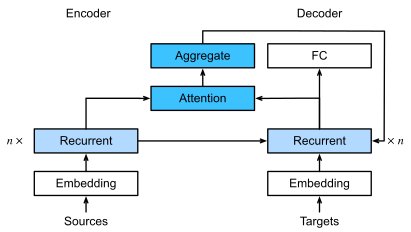
図 11.4.2 バーダナウ注意機構を用いた RNN エンコーダ–デコーダモデルの層。
11.4.2. 注意付きデコーダの定義
注意付き RNN エンコーダ–デコーダを実装するには、
デコーダを再定義するだけでよい(注意関数から生成済み記号を省くと設計が簡単になる)。まず、AttentionDecoder
クラスを定義して、注意付きデコーダの基本インターフェース
を定めよう。名前からして驚くほどではないが、AttentionDecoder
クラスである。
class AttentionDecoder(d2l.Decoder):  #@save
    """The base attention-based decoder interface."""
    def __init__(self):
        super().__init__()

    @property
    def attention_weights(self):
        raise NotImplementedError
class AttentionDecoder(d2l.Decoder):  #@save
    """The base attention-based decoder interface."""
    def __init__(self):
        super().__init__()

    @property
    def attention_weights(self):
        raise NotImplementedError
class Seq2SeqAttentionDecoder(nn.Module):
    vocab_size: int
    embed_size: int
    num_hiddens: int
    num_layers: int
    dropout: float = 0

    def setup(self):
        self.attention = d2l.AdditiveAttention(self.num_hiddens, self.dropout)
        self.embedding = nn.Embed(self.vocab_size, self.embed_size)
        self.dense = nn.Dense(self.vocab_size)
        self.rnn = d2l.GRU(num_hiddens, num_layers, dropout=self.dropout)

    def init_state(self, enc_outputs, enc_valid_lens, *args):
        # 出力の形状: (num_steps, batch_size, num_hiddens)
        # 隠れ状態の形状: (num_layers, batch_size, num_hiddens)
        outputs, hidden_state = enc_outputs
        # 注意: Attention weights は state の一部として返される; 初期値は None
        return (outputs.transpose(1, 0, 2), hidden_state, enc_valid_lens)

    @nn.compact
    def __call__(self, X, state, training=False):
        # enc_outputsの形状: (batch_size, num_steps, num_hiddens)。
        # 隠れ状態の形状: (num_layers, batch_size, num_hiddens)
        # 状態内の Attention 値を無視する
        enc_outputs, hidden_state, enc_valid_lens = state
        # 出力Xの形状: (num_steps, batch_size, embed_size)
        X = self.embedding(X).transpose(1, 0, 2)
        outputs, attention_weights = [], []
        for x in X:
            # クエリの形状: (batch_size, 1, num_hiddens)
            query = jnp.expand_dims(hidden_state[-1], axis=1)
            # コンテキストの形状: (batch_size, 1, num_hiddens)
            context, attention_w = self.attention(query, enc_outputs,
                                                  enc_outputs, enc_valid_lens,
                                                  training=training)
            # 特徴次元で連結する
            x = jnp.concatenate((context, jnp.expand_dims(x, axis=1)), axis=-1)
            # x を (1, batch_size, embed_size + num_hiddens) に reshape する
            out, hidden_state = self.rnn(x.transpose(1, 0, 2), hidden_state,
                                         training=training)
            outputs.append(out)
            attention_weights.append(attention_w)

        # Flax sow APIは中間変数を捕捉するために用いられる
        self.sow('intermediates', 'dec_attention_weights', attention_weights)

        # 全結合層による変換後の出力の形状:
        # (num_steps, batch_size, vocab_size)
        outputs = self.dense(jnp.concatenate(outputs, axis=0))
        return outputs.transpose(1, 0, 2), [enc_outputs, hidden_state,
                                            enc_valid_lens]
class AttentionDecoder(d2l.Decoder):  #@save
    """The base attention-based decoder interface."""
    def __init__(self):
        super().__init__()

    @property
    def attention_weights(self):
        raise NotImplementedError
Seq2SeqAttentionDecoder クラスで RNN デコーダを実装する 必要がある。
デコーダの状態は次の要素で初期化される。 (i)
注意のキーと値として使われる、すべての時刻におけるエンコーダ最終層の隠れ状態;
(ii)
デコーダの隠れ状態を初期化するために使われる、最終時刻におけるエンコーダの全層の隠れ状態;
(iii)
注意プーリングでパディングトークンを除外するための、エンコーダの有効長。
各デコード時刻では、前の時刻で得られたデコーダ最終層の隠れ状態が、注意機構のクエリとして使われる。
注意機構の出力と入力埋め込みの両方を連結し、RNN デコーダの入力とする。
class Seq2SeqAttentionDecoder(AttentionDecoder):
    def __init__(self, vocab_size, embed_size, num_hiddens, num_layers,
                 dropout=0):
        super().__init__()
        self.attention = d2l.AdditiveAttention(num_hiddens, dropout)
        self.embedding = nn.Embedding(vocab_size, embed_size)
        self.rnn = nn.GRU(
            embed_size + num_hiddens, num_hiddens, num_layers,
            dropout=dropout)
        self.dense = nn.LazyLinear(vocab_size)
        self.apply(d2l.init_seq2seq)

    def init_state(self, enc_outputs, enc_valid_lens):
        # 出力の形状: (num_steps, batch_size, num_hiddens)
        # 隠れ状態の形状: (num_layers, batch_size, num_hiddens)
        outputs, hidden_state = enc_outputs
        return (outputs.permute(1, 0, 2), hidden_state, enc_valid_lens)

    def forward(self, X, state):
        # enc_outputsの形状: (batch_size, num_steps, num_hiddens)。
        # 隠れ状態の形状: (num_layers, batch_size, num_hiddens)
        enc_outputs, hidden_state, enc_valid_lens = state
        # 出力Xの形状: (num_steps, batch_size, embed_size)
        X = self.embedding(X).permute(1, 0, 2)
        outputs, self._attention_weights = [], []
        for x in X:
            # クエリの形状: (batch_size, 1, num_hiddens)
            query = torch.unsqueeze(hidden_state[-1], dim=1)
            # コンテキストの形状: (batch_size, 1, num_hiddens)
            context = self.attention(
                query, enc_outputs, enc_outputs, enc_valid_lens)
            # 特徴次元で連結する
            x = torch.cat((context, torch.unsqueeze(x, dim=1)), dim=-1)
            # x を (1, batch_size, embed_size + num_hiddens) に reshape する
            out, hidden_state = self.rnn(x.permute(1, 0, 2), hidden_state)
            outputs.append(out)
            self._attention_weights.append(self.attention.attention_weights)
        # 全結合層による変換後の出力の形状:
        # (num_steps, batch_size, vocab_size)
        outputs = self.dense(torch.cat(outputs, dim=0))
        return outputs.permute(1, 0, 2), [enc_outputs, hidden_state,
                                          enc_valid_lens]

    @property
    def attention_weights(self):
        return self._attention_weights
class Seq2SeqAttentionDecoder(AttentionDecoder):
    def __init__(self, vocab_size, embed_size, num_hiddens, num_layers,
                 dropout=0):
        super().__init__()
        self.attention = d2l.AdditiveAttention(num_hiddens, dropout)
        self.embedding = nn.Embedding(vocab_size, embed_size)
        self.rnn = rnn.GRU(num_hiddens, num_layers, dropout=dropout)
        self.dense = nn.Dense(vocab_size, flatten=False)
        self.initialize(init.Xavier())

    def init_state(self, enc_outputs, enc_valid_lens):
        # 出力の形状: (num_steps, batch_size, num_hiddens)
        # 隠れ状態の形状: (num_layers, batch_size, num_hiddens)
        outputs, hidden_state = enc_outputs
        return (outputs.swapaxes(0, 1), hidden_state, enc_valid_lens)

    def forward(self, X, state):
        # enc_outputsの形状: (batch_size, num_steps, num_hiddens)。
        # 隠れ状態の形状: (num_layers, batch_size, num_hiddens)
        enc_outputs, hidden_state, enc_valid_lens = state
        # 出力Xの形状: (num_steps, batch_size, embed_size)
        X = self.embedding(X).swapaxes(0, 1)
        outputs, self._attention_weights = [], []
        for x in X:
            # クエリの形状: (batch_size, 1, num_hiddens)
            query = np.expand_dims(hidden_state[-1], axis=1)
            # コンテキストの形状: (batch_size, 1, num_hiddens)
            context = self.attention(
                query, enc_outputs, enc_outputs, enc_valid_lens)
            # 特徴次元で連結する
            x = np.concatenate((context, np.expand_dims(x, axis=1)), axis=-1)
            # x を (1, batch_size, embed_size + num_hiddens) に reshape する
            out, hidden_state = self.rnn(x.swapaxes(0, 1), hidden_state)
            hidden_state = hidden_state[0]
            outputs.append(out)
            self._attention_weights.append(self.attention.attention_weights)
        # 全結合層による変換後の出力の形状:
        # (num_steps, batch_size, vocab_size)
        outputs = self.dense(np.concatenate(outputs, axis=0))
        return outputs.swapaxes(0, 1), [enc_outputs, hidden_state,
                                        enc_valid_lens]

    @property
    def attention_weights(self):
        return self._attention_weights
vocab_size, embed_size, num_hiddens, num_layers = 10, 8, 16, 2
batch_size, num_steps = 4, 7
encoder = d2l.Seq2SeqEncoder(vocab_size, embed_size, num_hiddens, num_layers)
decoder = Seq2SeqAttentionDecoder(vocab_size, embed_size, num_hiddens,
                                  num_layers)
X = jnp.zeros((batch_size, num_steps), dtype=jnp.int32)
state = decoder.init_state(encoder.init_with_output(d2l.get_key(),
                                                    X, training=False)[0],
                           None)
(output, state), _ = decoder.init_with_output(d2l.get_key(), X,
                                              state, training=False)
d2l.check_shape(output, (batch_size, num_steps, vocab_size))
d2l.check_shape(state[0], (batch_size, num_steps, num_hiddens))
d2l.check_shape(state[1][0], (batch_size, num_hiddens))
class Seq2SeqAttentionDecoder(AttentionDecoder):
    def __init__(self, vocab_size, embed_size, num_hiddens, num_layers,
                 dropout=0):
        super().__init__()
        self.attention = d2l.AdditiveAttention(num_hiddens, num_hiddens,
                                               num_hiddens, dropout)
        self.embedding = tf.keras.layers.Embedding(vocab_size, embed_size)
        self.rnn = tf.keras.layers.RNN(tf.keras.layers.StackedRNNCells(
            [tf.keras.layers.GRUCell(num_hiddens, dropout=dropout)
             for _ in range(num_layers)]), return_sequences=True,
                                       return_state=True)
        self.dense = tf.keras.layers.Dense(vocab_size)

    def init_state(self, enc_outputs, enc_valid_lens):
        # 出力の形状: (batch_size, num_steps, num_hiddens)
        # hidden_stateの長さはnum_layersであり、その形状は
        # 要素の形状は (batch_size, num_hiddens) である
        outputs, hidden_state = enc_outputs
        return (tf.transpose(outputs, (1, 0, 2)), hidden_state,
                enc_valid_lens)

    def call(self, X, state, **kwargs):
        # 出力 enc_outputs の形状: # (batch_size, num_steps, num_hiddens)
        # hidden_stateの長さはnum_layersであり、その形状は
        # 要素の形状は (batch_size, num_hiddens) である
        enc_outputs, hidden_state, enc_valid_lens = state
        # 出力Xの形状: (num_steps, batch_size, embed_size)
        X = self.embedding(X)  # 入力Xの形状は(batch_size, num_steps)である
        X = tf.transpose(X, perm=(1, 0, 2))
        outputs, self._attention_weights = [], []
        for x in X:
            # クエリの形状: (batch_size, 1, num_hiddens)
            query = tf.expand_dims(hidden_state[-1], axis=1)
            # コンテキストの形状: (batch_size, 1, num_hiddens)
            context = self.attention(query, enc_outputs, enc_outputs,
                                     enc_valid_lens, **kwargs)
            # 特徴次元で連結する
            x = tf.concat((context, tf.expand_dims(x, axis=1)), axis=-1)
            out = self.rnn(x, hidden_state, **kwargs)
            hidden_state = out[1:]
            outputs.append(out[0])
            self._attention_weights.append(self.attention.attention_weights)
        # 全結合層による変換後の出力の形状:
        # (batch_size, num_steps, vocab_size)
        outputs = self.dense(tf.concat(outputs, axis=1))
        return outputs, [enc_outputs, hidden_state, enc_valid_lens]

    @property
    def attention_weights(self):
        return self._attention_weights
以下では、長さ7の時系列をそれぞれ持つ4つの系列からなるミニバッチを用いて、実装した注意付きデコーダをテストする。
vocab_size, embed_size, num_hiddens, num_layers = 10, 8, 16, 2
batch_size, num_steps = 4, 7
encoder = d2l.Seq2SeqEncoder(vocab_size, embed_size, num_hiddens, num_layers)
decoder = Seq2SeqAttentionDecoder(vocab_size, embed_size, num_hiddens,
                                  num_layers)
X = d2l.zeros((batch_size, num_steps), dtype=torch.long)
state = decoder.init_state(encoder(X), None)
output, state = decoder(X, state)
d2l.check_shape(output, (batch_size, num_steps, vocab_size))
d2l.check_shape(state[0], (batch_size, num_steps, num_hiddens))
d2l.check_shape(state[1][0], (batch_size, num_hiddens))
vocab_size, embed_size, num_hiddens, num_layers = 10, 8, 16, 2
batch_size, num_steps = 4, 7
encoder = d2l.Seq2SeqEncoder(vocab_size, embed_size, num_hiddens, num_layers)
decoder = Seq2SeqAttentionDecoder(vocab_size, embed_size, num_hiddens,
                                  num_layers)
X = d2l.zeros((batch_size, num_steps))
state = decoder.init_state(encoder(X), None)
output, state = decoder(X, state)
d2l.check_shape(output, (batch_size, num_steps, vocab_size))
d2l.check_shape(state[0], (batch_size, num_steps, num_hiddens))
d2l.check_shape(state[1][0], (batch_size, num_hiddens))
[08:07:30] ../src/storage/storage.cc:196: Using Pooled (Naive) StorageManager for CPU
data = d2l.MTFraEng(batch_size=128)
embed_size, num_hiddens, num_layers, dropout = 256, 256, 2, 0.2
encoder = d2l.Seq2SeqEncoder(
    len(data.src_vocab), embed_size, num_hiddens, num_layers, dropout)
decoder = Seq2SeqAttentionDecoder(
    len(data.tgt_vocab), embed_size, num_hiddens, num_layers, dropout)
model = d2l.Seq2Seq(encoder, decoder, tgt_pad=data.tgt_vocab['<pad>'],
                    lr=0.005, training=True)
trainer = d2l.Trainer(max_epochs=30, gradient_clip_val=1, num_gpus=1)
trainer.fit(model, data)
vocab_size, embed_size, num_hiddens, num_layers = 10, 8, 16, 2
batch_size, num_steps = 4, 7
encoder = d2l.Seq2SeqEncoder(vocab_size, embed_size, num_hiddens, num_layers)
decoder = Seq2SeqAttentionDecoder(vocab_size, embed_size, num_hiddens,
                                  num_layers)
X = tf.zeros((batch_size, num_steps))
state = decoder.init_state(encoder(X, training=False), None)
output, state = decoder(X, state, training=False)
d2l.check_shape(output, (batch_size, num_steps, vocab_size))
d2l.check_shape(state[0], (batch_size, num_steps, num_hiddens))
d2l.check_shape(state[1][0], (batch_size, num_hiddens))
11.4.3. 学習
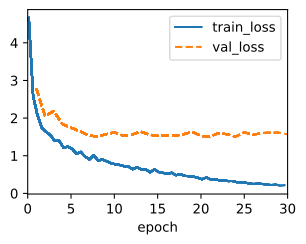
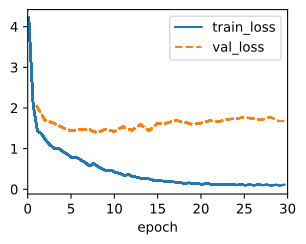
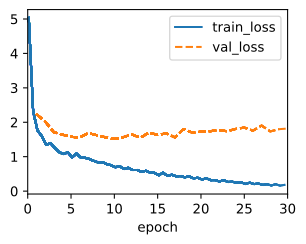
新しいデコーダを定義したので、 10.7.6 章 と同様に進められる。 すなわち、ハイパーパラメータを指定し、通常のエンコーダと注意付きデコーダをインスタンス化し、このモデルを機械翻訳のために学習する。
data = d2l.MTFraEng(batch_size=128)
embed_size, num_hiddens, num_layers, dropout = 256, 256, 2, 0.2
encoder = d2l.Seq2SeqEncoder(
    len(data.src_vocab), embed_size, num_hiddens, num_layers, dropout)
decoder = Seq2SeqAttentionDecoder(
    len(data.tgt_vocab), embed_size, num_hiddens, num_layers, dropout)
model = d2l.Seq2Seq(encoder, decoder, tgt_pad=data.tgt_vocab['<pad>'],
                    lr=0.005)
trainer = d2l.Trainer(max_epochs=30, gradient_clip_val=1, num_gpus=1)
trainer.fit(model, data)
data = d2l.MTFraEng(batch_size=128)
embed_size, num_hiddens, num_layers, dropout = 256, 256, 2, 0.2
encoder = d2l.Seq2SeqEncoder(
    len(data.src_vocab), embed_size, num_hiddens, num_layers, dropout)
decoder = Seq2SeqAttentionDecoder(
    len(data.tgt_vocab), embed_size, num_hiddens, num_layers, dropout)
model = d2l.Seq2Seq(encoder, decoder, tgt_pad=data.tgt_vocab['<pad>'],
                    lr=0.005)
trainer = d2l.Trainer(max_epochs=30, gradient_clip_val=1, num_gpus=1)
trainer.fit(model, data)
engs = ['go .', 'i lost .', 'he\'s calm .', 'i\'m home .']
fras = ['va !', 'j\'ai perdu .', 'il est calme .', 'je suis chez moi .']
preds, _ = model.predict_step(
    trainer.state.params, data.build(engs, fras), data.num_steps)
for en, fr, p in zip(engs, fras, preds):
    translation = []
    for token in data.tgt_vocab.to_tokens(p):
        if token == '<eos>':
            break
        translation.append(token)
    print(f'{en} => {translation}, bleu,'
          f'{d2l.bleu(" ".join(translation), fr, k=2):.3f}')
go . => ['<unk>', '.'], bleu,0.000
i lost . => ['je', 'me', 'suis', '<unk>', '.'], bleu,0.000
he's calm . => ['assieds-toi', 'ici', '.'], bleu,0.000
i'm home . => ['je', 'suis', 'chez', 'moi', '.'], bleu,1.000
data = d2l.MTFraEng(batch_size=128)
embed_size, num_hiddens, num_layers, dropout = 256, 256, 2, 0.2
with d2l.try_gpu():
    encoder = d2l.Seq2SeqEncoder(
        len(data.src_vocab), embed_size, num_hiddens, num_layers, dropout)
    decoder = Seq2SeqAttentionDecoder(
        len(data.tgt_vocab), embed_size, num_hiddens, num_layers, dropout)
    model = d2l.Seq2Seq(encoder, decoder, tgt_pad=data.tgt_vocab['<pad>'],
                        lr=0.005)
trainer = d2l.Trainer(max_epochs=30, gradient_clip_val=1)
trainer.fit(model, data)
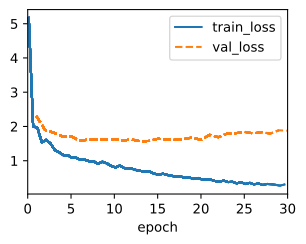
モデルを学習した後、 それを用いて いくつかの英語文をフランス語に翻訳 し、 それらの BLEU スコアを計算する。
engs = ['go .', 'i lost .', 'he\'s calm .', 'i\'m home .']
fras = ['va !', 'j\'ai perdu .', 'il est calme .', 'je suis chez moi .']
preds, _ = model.predict_step(
    data.build(engs, fras), d2l.try_gpu(), data.num_steps)
for en, fr, p in zip(engs, fras, preds):
    translation = []
    for token in data.tgt_vocab.to_tokens(p):
        if token == '<eos>':
            break
        translation.append(token)
    print(f'{en} => {translation}, bleu,'
          f'{d2l.bleu(" ".join(translation), fr, k=2):.3f}')
go . => ['va', '!'], bleu,1.000
i lost . => ["j'ai", 'perdu', '.'], bleu,1.000
he's calm . => ['je', 'suis', 'calme', '.'], bleu,0.537
i'm home . => ['je', 'suis', 'chez', 'moi', '.'], bleu,1.000
engs = ['go .', 'i lost .', 'he\'s calm .', 'i\'m home .']
fras = ['va !', 'j\'ai perdu .', 'il est calme .', 'je suis chez moi .']
preds, _ = model.predict_step(
    data.build(engs, fras), d2l.try_gpu(), data.num_steps)
for en, fr, p in zip(engs, fras, preds):
    translation = []
    for token in data.tgt_vocab.to_tokens(p):
        if token == '<eos>':
            break
        translation.append(token)
    print(f'{en} => {translation}, bleu,'
          f'{d2l.bleu(" ".join(translation), fr, k=2):.3f}')
go . => ['<unk>', '!'], bleu,0.000
i lost . => ["j'ai", 'perdu', '.'], bleu,1.000
he's calm . => ['tom', 'a', 'gagné', '.'], bleu,0.000
i'm home . => ['je', 'suis', 'chez', 'moi', '.'], bleu,1.000
_, (dec_attention_weights, _) = model.predict_step(
    trainer.state.params, data.build([engs[-1]], [fras[-1]]),
    data.num_steps, True)
attention_weights = d2l.concat(
    [step[0][0][0] for step in dec_attention_weights], 0)
attention_weights = d2l.reshape(attention_weights, (1, 1, -1, data.num_steps))
engs = ['go .', 'i lost .', 'he\'s calm .', 'i\'m home .']
fras = ['va !', 'j\'ai perdu .', 'il est calme .', 'je suis chez moi .']
preds, _ = model.predict_step(
    data.build(engs, fras), d2l.try_gpu(), data.num_steps)
for en, fr, p in zip(engs, fras, preds):
    translation = []
    for token in data.tgt_vocab.to_tokens(p):
        if token == '<eos>':
            break
        translation.append(token)
    print(f'{en} => {translation}, bleu,'
          f'{d2l.bleu(" ".join(translation), fr, k=2):.3f}')
go . => ['vas-y', '.'], bleu,0.000
i lost . => ['je', 'me', 'refuse', '.'], bleu,0.000
he's calm . => ['il', 'est', 'mouillé', '.'], bleu,0.658
i'm home . => ['je', 'suis', 'bien', '.'], bleu,0.512
最後の英語文を翻訳するときの 注意重みを可視化 してみよう。 各クエリがキー–値のペアに対して非一様な重みを割り当てていることがわかる。 これは、各デコードステップで入力系列の異なる部分が注意プーリングで選択的に集約されていることを示している。
_, dec_attention_weights = model.predict_step(
    data.build([engs[-1]], [fras[-1]]), d2l.try_gpu(), data.num_steps, True)
attention_weights = d2l.concat(
    [step[0][0][0] for step in dec_attention_weights], 0)
attention_weights = d2l.reshape(attention_weights, (1, 1, -1, data.num_steps))
_, dec_attention_weights = model.predict_step(
    data.build([engs[-1]], [fras[-1]]), d2l.try_gpu(), data.num_steps, True)
attention_weights = d2l.concat(
    [step[0][0][0] for step in dec_attention_weights], 0)
attention_weights = d2l.reshape(attention_weights, (1, 1, -1, data.num_steps))
# 終端トークンを含めるために1を加える
d2l.show_heatmaps(attention_weights[:, :, :, :len(engs[-1].split()) + 1],
                  xlabel='Key positions', ylabel='Query positions')

_, dec_attention_weights = model.predict_step(
    data.build([engs[-1]], [fras[-1]]), d2l.try_gpu(), data.num_steps, True)
attention_weights = d2l.concat(
    [step[0][0][0] for step in dec_attention_weights], 0)
attention_weights = d2l.reshape(attention_weights, (1, 1, -1, data.num_steps))
# 終端トークンを含めるために1を加える
d2l.show_heatmaps(
    attention_weights[:, :, :, :len(engs[-1].split()) + 1].cpu(),
    xlabel='Key positions', ylabel='Query positions')

# 終端トークンを含めるために1を加える
d2l.show_heatmaps(
    attention_weights[:, :, :, :len(engs[-1].split()) + 1],
    xlabel='Key positions', ylabel='Query positions')

# 終端トークンを含めるために1を加える
d2l.show_heatmaps(attention_weights[:, :, :, :len(engs[-1].split()) + 1],
                  xlabel='Key positions', ylabel='Query positions')

11.4.4. まとめ
トークンを予測するとき、入力トークンのすべてが関連するとは限らない場合、バーダナウ注意機構を備えた RNN エンコーダ–デコーダは入力系列の異なる部分を選択的に集約する。、状態(コンテキスト変数)を加法的注意プーリングの出力として扱うことで実現される。 RNN エンコーダ–デコーダでは、バーダナウ注意機構は前時刻のデコーダ隠れ状態をクエリとして扱い、すべての時刻におけるエンコーダ隠れ状態をキーと値の両方として扱う。
11.4.5. 演習
実験で GRU を LSTM に置き換えよ。
実験を修正して、加法的注意スコア関数をスケールド・ドット積に置き換えよ。学習効率にどのような影響があるか。