
13.5. 複数GPUでの学習
nvidia-smi
コマンドを使ってコンピュータ上で利用可能なGPUをすべて一覧表示する方法も示した。13.5.1. 問題の分割
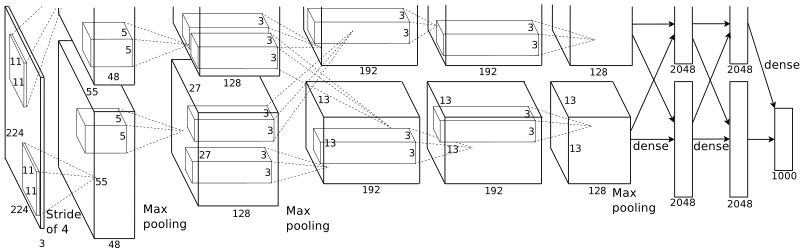
図 13.5.1 メモリ制約のために元のAlexNet設計で用いられたモデル並列。
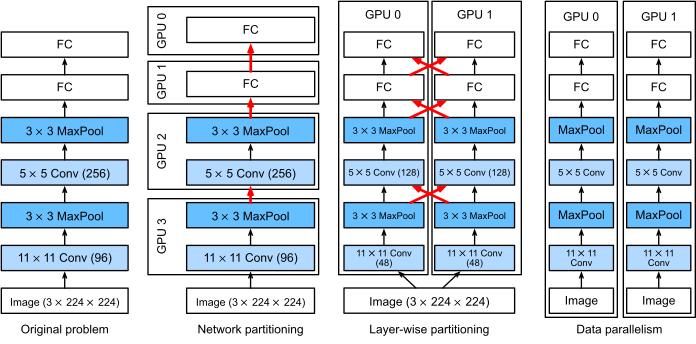
図 13.5.2 複数GPU上での並列化。左から右へ:元の問題、ネットワーク分割、層単位分割、データ並列。
13.5.2. データ並列
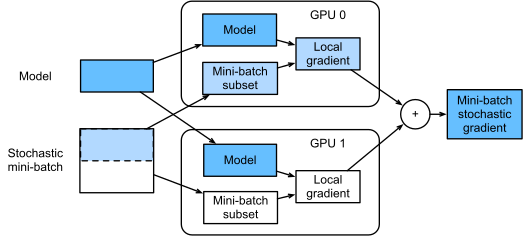
図 13.5.3 2枚のGPU上でデータ並列を用いてミニバッチ確率的勾配降下法を計算する様子。
一般に、学習は次のように進みる。
学習の任意の反復で、ランダムなミニバッチが与えられたら、バッチ内の例を \(k\) 個の部分に分け、GPUに均等に分配する。
各GPUは、自分に割り当てられたミニバッチ部分に基づいて、モデルパラメータの損失と勾配を計算する。
\(k\) 枚のGPUの局所勾配を集約して、現在のミニバッチ確率的勾配を得る。
集約された勾配を各GPUに再配布する。
各GPUは、このミニバッチ確率的勾配を使って、自分が保持しているモデルパラメータの完全な集合を更新する。
%matplotlib inline
from d2l import torch as d2l
import torch
from torch import nn
from torch.nn import functional as F
%matplotlib inline
from d2l import mxnet as d2l
from mxnet import autograd, gluon, np, npx
npx.set_np()
new_params = get_params(params, d2l.try_gpu(0))
print('b1 weight:', new_params[1])
print('b1 grad:', new_params[1].grad)
new_params = get_params(params, d2l.try_gpu(0))
print('b1 weight:', new_params[1])
print('b1 grad:', new_params[1].grad)
13.5.3. おもちゃのネットワーク
7.6 章 で導入した LeNet を少し変更して使う。パラメータ交換と同期を詳細に示すため、これをゼロから定義する。
# モデルパラメータを初期化する
scale = 0.01
W1 = torch.randn(size=(20, 1, 3, 3)) * scale
b1 = torch.zeros(20)
W2 = torch.randn(size=(50, 20, 5, 5)) * scale
b2 = torch.zeros(50)
W3 = torch.randn(size=(800, 128)) * scale
b3 = torch.zeros(128)
W4 = torch.randn(size=(128, 10)) * scale
b4 = torch.zeros(10)
params = [W1, b1, W2, b2, W3, b3, W4, b4]

# モデルを定義する
def lenet(X, params):
    h1_conv = F.conv2d(input=X, weight=params[0], bias=params[1])
    h1_activation = F.relu(h1_conv)
    h1 = F.avg_pool2d(input=h1_activation, kernel_size=(2, 2), stride=(2, 2))
    h2_conv = F.conv2d(input=h1, weight=params[2], bias=params[3])
    h2_activation = F.relu(h2_conv)
    h2 = F.avg_pool2d(input=h2_activation, kernel_size=(2, 2), stride=(2, 2))
    h2 = h2.reshape(h2.shape[0], -1)
    h3_linear = torch.mm(h2, params[4]) + params[5]
    h3 = F.relu(h3_linear)
    y_hat = torch.mm(h3, params[6]) + params[7]
    return y_hat

# クロスエントロピー損失関数
loss = nn.CrossEntropyLoss(reduction='none')
# モデルパラメータを初期化する
scale = 0.01
W1 = np.random.normal(scale=scale, size=(20, 1, 3, 3))
b1 = np.zeros(20)
W2 = np.random.normal(scale=scale, size=(50, 20, 5, 5))
b2 = np.zeros(50)
W3 = np.random.normal(scale=scale, size=(800, 128))
b3 = np.zeros(128)
W4 = np.random.normal(scale=scale, size=(128, 10))
b4 = np.zeros(10)
params = [W1, b1, W2, b2, W3, b3, W4, b4]

# モデルを定義する
def lenet(X, params):
    h1_conv = npx.convolution(data=X, weight=params[0], bias=params[1],
                              kernel=(3, 3), num_filter=20)
    h1_activation = npx.relu(h1_conv)
    h1 = npx.pooling(data=h1_activation, pool_type='avg', kernel=(2, 2),
                     stride=(2, 2))
    h2_conv = npx.convolution(data=h1, weight=params[2], bias=params[3],
                              kernel=(5, 5), num_filter=50)
    h2_activation = npx.relu(h2_conv)
    h2 = npx.pooling(data=h2_activation, pool_type='avg', kernel=(2, 2),
                     stride=(2, 2))
    h2 = h2.reshape(h2.shape[0], -1)
    h3_linear = np.dot(h2, params[4]) + params[5]
    h3 = npx.relu(h3_linear)
    y_hat = np.dot(h3, params[6]) + params[7]
    return y_hat

# クロスエントロピー損失関数
loss = gluon.loss.SoftmaxCrossEntropyLoss()
[07:25:19] ../src/storage/storage.cc:196: Using Pooled (Naive) StorageManager for CPU
train(num_gpus=1, batch_size=256, lr=0.2)
train(num_gpus=1, batch_size=256, lr=0.2)
13.5.4. データ同期
get_params)が必要である。パラメータがなければ、GPU上でネットワークを評価することはできない。allreduce
関数が必要である。def get_params(params, device):
new_params = [p.to(device) for p in params]
for p in new_params:
p.requires_grad_()
return new_params
def get_params(params, device):
    new_params = [p.copyto(device) for p in params]
    for p in new_params:
        p.attach_grad()
    return new_params
train(num_gpus=2, batch_size=256, lr=0.2)
train(num_gpus=2, batch_size=256, lr=0.2)
モデルパラメータを1枚のGPUにコピーして試してみよう。
new_params = get_params(params, d2l.try_gpu(0))
print('b1 weight:', new_params[1])
print('b1 grad:', new_params[1].grad)
b1 weight: tensor([0., 0., 0., 0., 0., 0., 0., 0., 0., 0., 0., 0., 0., 0., 0., 0., 0., 0., 0., 0.],
       device='cuda:0', requires_grad=True)
b1 grad: None
allreduce
関数は、すべてのベクトルを加算し、その結果をすべてのGPUにブロードキャストする。これを動かすには、結果を集約するデバイスへデータをコピーする必要があることに注意しようう。def allreduce(data):
for i in range(1, len(data)):
data[0][:] += data[i].to(data[0].device)
for i in range(1, len(data)):
data[i][:] = data[0].to(data[i].device)
def allreduce(data):
    for i in range(1, len(data)):
        data[0][:] += data[i].copyto(data[0].ctx)
    for i in range(1, len(data)):
        data[0].copyto(data[i])
異なるデバイス上で異なる値を持つベクトルを作成し、それらを集約してみよう。
data = [torch.ones((1, 2), device=d2l.try_gpu(i)) * (i + 1) for i in range(2)]
print('before allreduce:\n', data[0], '\n', data[1])
allreduce(data)
print('after allreduce:\n', data[0], '\n', data[1])
before allreduce:
 tensor([[1., 1.]], device='cuda:0')
 tensor([[2., 2.]], device='cuda:1')
after allreduce:
 tensor([[3., 3.]], device='cuda:0')
 tensor([[3., 3.]], device='cuda:1')
data = [np.ones((1, 2), ctx=d2l.try_gpu(i)) * (i + 1) for i in range(2)]
print('before allreduce:\n', data[0], '\n', data[1])
allreduce(data)
print('after allreduce:\n', data[0], '\n', data[1])
[07:25:20] ../src/storage/storage.cc:196: Using Pooled (Naive) StorageManager for GPU
before allreduce:
 [[1. 1.]] @gpu(0)
 [[2. 2.]] @gpu(1)
after allreduce:
 [[3. 3.]] @gpu(0)
 [[3. 3.]] @gpu(1)
13.5.5. データの分配
data = torch.arange(20).reshape(4, 5)
devices = [torch.device('cuda:0'), torch.device('cuda:1')]
split = nn.parallel.scatter(data, devices)
print('input :', data)
print('load into', devices)
print('output:', split)
input : tensor([[ 0,  1,  2,  3,  4],
        [ 5,  6,  7,  8,  9],
        [10, 11, 12, 13, 14],
        [15, 16, 17, 18, 19]])
load into [device(type='cuda', index=0), device(type='cuda', index=1)]
output: (tensor([[0, 1, 2, 3, 4],
        [5, 6, 7, 8, 9]], device='cuda:0'), tensor([[10, 11, 12, 13, 14],
        [15, 16, 17, 18, 19]], device='cuda:1'))
data = np.arange(20).reshape(4, 5)
devices = [npx.gpu(0), npx.gpu(1)]
split = gluon.utils.split_and_load(data, devices)
print('input :', data)
print('load into', devices)
print('output:', split)
input : [[ 0.  1.  2.  3.  4.]
 [ 5.  6.  7.  8.  9.]
 [10. 11. 12. 13. 14.]
 [15. 16. 17. 18. 19.]]
load into [gpu(0), gpu(1)]
output: [array([[0., 1., 2., 3., 4.],
       [5., 6., 7., 8., 9.]], ctx=gpu(0)), array([[10., 11., 12., 13., 14.],
       [15., 16., 17., 18., 19.]], ctx=gpu(1))]
後で再利用できるように、データとラベルの両方を分割する split_batch
関数を定義する。
#@save
def split_batch(X, y, devices):
    """Split `X` and `y` into multiple devices."""
    assert X.shape[0] == y.shape[0]
    return (nn.parallel.scatter(X, devices),
            nn.parallel.scatter(y, devices))
#@save
def split_batch(X, y, devices):
    """Split `X` and `y` into multiple devices."""
    assert X.shape[0] == y.shape[0]
    return (gluon.utils.split_and_load(X, devices),
            gluon.utils.split_and_load(y, devices))
13.5.6. 学習
これで、単一ミニバッチに対する複数GPU学習
を実装できる。その実装は主として、本節で説明したデータ並列のアプローチに基づいている。複数GPU間でデータを同期するために、先ほど説明した補助関数
allreduce と split_and_load
を使う。並列性を実現するために特別なコードを書く必要がないことに注意しようう。ミニバッチ内では計算グラフにデバイス間の依存関係がないため、計算は
自動的に 並列実行される。
def train_batch(X, y, device_params, devices, lr):
    X_shards, y_shards = split_batch(X, y, devices)
    # 損失は各GPUで個別に計算される
    ls = [loss(lenet(X_shard, device_W), y_shard).sum()
          for X_shard, y_shard, device_W in zip(
              X_shards, y_shards, device_params)]
    for l in ls:  # バックプロパゲーションは各GPUで別々に実行される
        l.backward()
    # 各GPUからの勾配をすべて集約し、全GPUにブロードキャストする
    with torch.no_grad():
        for i in range(len(device_params[0])):
            allreduce([device_params[c][i].grad for c in range(len(devices))])
    # モデルのパラメータは各GPUで個別に更新される
    for param in device_params:
        d2l.sgd(param, lr, X.shape[0]) # ここではフルサイズのバッチを用いる
def train_batch(X, y, device_params, devices, lr):
    X_shards, y_shards = split_batch(X, y, devices)
    with autograd.record():  # 損失は各GPUで個別に計算される
        ls = [loss(lenet(X_shard, device_W), y_shard)
              for X_shard, y_shard, device_W in zip(
                  X_shards, y_shards, device_params)]
    for l in ls:  # バックプロパゲーションは各GPUで別々に実行される
        l.backward()
    # 各GPUからの勾配をすべて集約し、全GPUにブロードキャストする
    for i in range(len(device_params[0])):
        allreduce([device_params[c][i].grad for c in range(len(devices))])
    # モデルのパラメータは各GPUで個別に更新される
    for param in device_params:
        d2l.sgd(param, lr, X.shape[0])  # ここではフルサイズのバッチを用いる
train_batch
関数で処理される。便宜上(そしてコードを簡潔にするため)、精度の計算は1枚のGPU上で行うが、他のGPUはアイドル状態になるため、
非効率的 である。def train(num_gpus, batch_size, lr):
train_iter, test_iter = d2l.load_data_fashion_mnist(batch_size)
devices = [d2l.try_gpu(i) for i in range(num_gpus)]
# モデルのパラメータを`num_gpus`個のGPUにコピーする
device_params = [get_params(params, d) for d in devices]
num_epochs = 10
animator = d2l.Animator('epoch', 'test acc', xlim=[1, num_epochs])
timer = d2l.Timer()
for epoch in range(num_epochs):
timer.start()
for X, y in train_iter:
# 単一ミニバッチに対してマルチGPU学習を行う
train_batch(X, y, device_params, devices, lr)
torch.cuda.synchronize()
timer.stop()
# GPU 0上でモデルを評価する
animator.add(epoch + 1, (d2l.evaluate_accuracy_gpu(
lambda x: lenet(x, device_params[0]), test_iter, devices[0]),))
print(f'test acc: {animator.Y[0][-1]:.2f}, {timer.avg():.1f} sec/epoch '
f'on {str(devices)}')
def train(num_gpus, batch_size, lr):
    train_iter, test_iter = d2l.load_data_fashion_mnist(batch_size)
    devices = [d2l.try_gpu(i) for i in range(num_gpus)]
    # モデルのパラメータを`num_gpus`個のGPUにコピーする
    device_params = [get_params(params, d) for d in devices]
    num_epochs = 10
    animator = d2l.Animator('epoch', 'test acc', xlim=[1, num_epochs])
    timer = d2l.Timer()
    for epoch in range(num_epochs):
        timer.start()
        for X, y in train_iter:
            # 単一ミニバッチに対してマルチGPU学習を行う
            train_batch(X, y, device_params, devices, lr)
            npx.waitall()
        timer.stop()
        # GPU 0上でモデルを評価する
        animator.add(epoch + 1, (d2l.evaluate_accuracy_gpu(
            lambda x: lenet(x, device_params[0]), test_iter, devices[0]),))
    print(f'test acc: {animator.Y[0][-1]:.2f}, {timer.avg():.1f} sec/epoch '
          f'on {str(devices)}')
train(num_gpus=1, batch_size=256, lr=0.2)
test acc: 0.82, 3.7 sec/epoch on [device(type='cuda', index=0)]
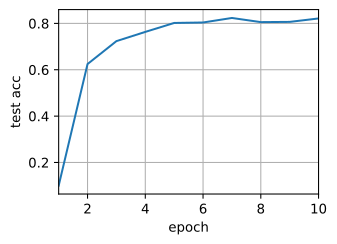
train(num_gpus=2, batch_size=256, lr=0.2)
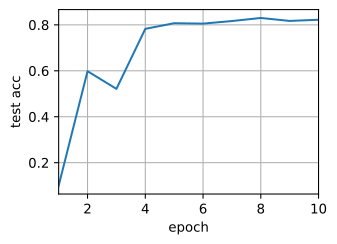
test acc: 0.82, 3.8 sec/epoch on [device(type='cuda', index=0), device(type='cuda', index=1)]
13.5.7. まとめ
深層ネットワークの学習を複数GPUに分割する方法はいくつかある。層間で分割する方法、層ごとに分割する方法、データに分割する方法である。前の2つは、綿密に調整されたデータ転送を必要とする。データ並列が最も単純な戦略である。
データ並列学習は簡単である。ただし、効率を高めるために実効ミニバッチサイズを増やする。
データ並列では、データを複数GPUに分割し、各GPUが独自に順伝播と逆伝播を実行し、その後で勾配を集約して結果をGPUにブロードキャストする。
より大きなミニバッチに対しては、学習率を少し大きくしてもよいだろう。
13.5.8. 演習
\(k\) 枚のGPUで学習するとき、ミニバッチサイズを \(b\) から \(k \cdot b\) に変更し、つまりGPU数に応じて拡大しなさい。
異なる学習率で精度を比較しなさい。GPU数に応じてどのようにスケールするか。
異なるGPU上の異なるパラメータを集約する、より効率的な
allreduce関数を実装しなさい。なぜそれがより効率的なのか。複数GPUでのテスト精度計算を実装しなさい。