
13.6. 複数GPUのための簡潔な実装
新しいモデルごとに並列化を一から実装するのは楽しいものではない。さらに、高性能を実現するためには同期ツールの最適化に大きな利点がある。以下では、深層学習フレームワークの高レベルAPIを使ってこれを行う方法を示す。 数学とアルゴリズムは 13.5 章 と同じである。 当然ながら、この節のコードを実行するには少なくとも2つのGPUが必要である。
from d2l import torch as d2l
import torch
from torch import nn
from d2l import mxnet as d2l
from mxnet import autograd, gluon, init, np, npx
from mxnet.gluon import nn
npx.set_np()
13.6.1. おもちゃのネットワーク
13.5 章 の LeNet よりも少し意味のある、それでいて十分に簡単かつ高速に学習できるネットワークを使いましょう。 ここでは ResNet-18 の変種 (He et al., 2016) を選ぶ。入力画像が小さいので、少し変更を加える。特に、 8.6 章 との違いは、最初の畳み込みでより小さいカーネル、ストライド、パディングを使うことである。 さらに、最大プーリング層を取り除きる。
#@save
def resnet18(num_classes, in_channels=1):
    """A slightly modified ResNet-18 model."""
    def resnet_block(in_channels, out_channels, num_residuals,
                     first_block=False):
        blk = []
        for i in range(num_residuals):
            if i == 0 and not first_block:
                blk.append(d2l.Residual(out_channels, use_1x1conv=True,
                                        strides=2))
            else:
                blk.append(d2l.Residual(out_channels))
        return nn.Sequential(*blk)

    # このモデルは、より小さい畳み込みカーネル、ストライド、パディングを使用し、
    # 最大プーリング層を除去する
    net = nn.Sequential(
        nn.Conv2d(in_channels, 64, kernel_size=3, stride=1, padding=1),
        nn.BatchNorm2d(64),
        nn.ReLU())
    net.add_module("resnet_block1", resnet_block(64, 64, 2, first_block=True))
    net.add_module("resnet_block2", resnet_block(64, 128, 2))
    net.add_module("resnet_block3", resnet_block(128, 256, 2))
    net.add_module("resnet_block4", resnet_block(256, 512, 2))
    net.add_module("global_avg_pool", nn.AdaptiveAvgPool2d((1,1)))
    net.add_module("fc", nn.Sequential(nn.Flatten(),
                                       nn.Linear(512, num_classes)))
    return net
#@save
def resnet18(num_classes):
    """A slightly modified ResNet-18 model."""
    def resnet_block(num_channels, num_residuals, first_block=False):
        blk = nn.Sequential()
        for i in range(num_residuals):
            if i == 0 and not first_block:
                blk.add(d2l.Residual(
                    num_channels, use_1x1conv=True, strides=2))
            else:
                blk.add(d2l.Residual(num_channels))
        return blk

    net = nn.Sequential()
    # このモデルは、より小さい畳み込みカーネル、ストライド、パディングを使用し、
    # 最大プーリング層を除去する
    net.add(nn.Conv2D(64, kernel_size=3, strides=1, padding=1),
            nn.BatchNorm(), nn.Activation('relu'))
    net.add(resnet_block(64, 2, first_block=True),
            resnet_block(128, 2),
            resnet_block(256, 2),
            resnet_block(512, 2))
    net.add(nn.GlobalAvgPool2D(), nn.Dense(num_classes))
    return net
13.6.2. ネットワークの初期化
学習ループの中でネットワークを初期化する。 初期化手法の復習については 5.4 章 を参照しよう。
net = resnet18(10)
# GPUの一覧を取得する
devices = d2l.try_all_gpus()
# ネットワークを訓練ループ内で初期化する
net = resnet18(10)
# GPUの一覧を取得する
devices = d2l.try_all_gpus()
# ネットワークのすべてのパラメータを初期化する
net.initialize(init=init.Normal(sigma=0.01), ctx=devices)
[07:09:59] ../src/storage/storage.cc:196: Using Pooled (Naive) StorageManager for CPU
[07:09:59] ../src/storage/storage.cc:196: Using Pooled (Naive) StorageManager for GPU
[07:10:00] ../src/storage/storage.cc:196: Using Pooled (Naive) StorageManager for GPU
13.6.3. 学習
これまでと同様に、効率的な並列化のためには学習コードがいくつかの基本機能を実行する必要がある。
ネットワークのパラメータをすべてのデバイス上で初期化する必要がある。
データセットを反復する間、ミニバッチをすべてのデバイスに分割する必要がある。
損失とその勾配をデバイス間で並列に計算する。
勾配を集約し、それに応じてパラメータを更新する。
最後に、ネットワークの最終性能を報告するために、精度を(再び並列に)計算する。学習ルーチンは、データの分割と集約が必要である点を除けば、前の章の実装とかなり似ている。
def train(net, num_gpus, batch_size, lr):
    train_iter, test_iter = d2l.load_data_fashion_mnist(batch_size)
    devices = [d2l.try_gpu(i) for i in range(num_gpus)]
    def init_weights(module):
        if type(module) in [nn.Linear, nn.Conv2d]:
            nn.init.normal_(module.weight, std=0.01)
    net.apply(init_weights)
    # モデルを複数GPUに設定する
    net = nn.DataParallel(net, device_ids=devices)
    trainer = torch.optim.SGD(net.parameters(), lr)
    loss = nn.CrossEntropyLoss()
    timer, num_epochs = d2l.Timer(), 10
    animator = d2l.Animator('epoch', 'test acc', xlim=[1, num_epochs])
    for epoch in range(num_epochs):
        net.train()
        timer.start()
        for X, y in train_iter:
            trainer.zero_grad()
            X, y = X.to(devices[0]), y.to(devices[0])
            l = loss(net(X), y)
            l.backward()
            trainer.step()
        timer.stop()
        animator.add(epoch + 1, (d2l.evaluate_accuracy_gpu(net, test_iter),))
    print(f'test acc: {animator.Y[0][-1]:.2f}, {timer.avg():.1f} sec/epoch '
          f'on {str(devices)}')
x = np.random.uniform(size=(4, 1, 28, 28))
x_shards = gluon.utils.split_and_load(x, devices)
net(x_shards[0]), net(x_shards[1])
[07:10:01] ../src/operator/cudnn_ops.cc:318: Auto-tuning cuDNN op, set MXNET_CUDNN_AUTOTUNE_DEFAULT to 0 to disable
[07:10:02] ../src/operator/cudnn_ops.cc:318: Auto-tuning cuDNN op, set MXNET_CUDNN_AUTOTUNE_DEFAULT to 0 to disable
[07:10:03] ../src/operator/cudnn_ops.cc:318: Auto-tuning cuDNN op, set MXNET_CUDNN_AUTOTUNE_DEFAULT to 0 to disable
[07:10:04] ../src/operator/cudnn_ops.cc:318: Auto-tuning cuDNN op, set MXNET_CUDNN_AUTOTUNE_DEFAULT to 0 to disable
(array([[ 2.2610207e-06,  2.2045981e-06, -5.4046786e-06,  1.2869955e-06,
          5.1373163e-06, -3.8297967e-06,  1.4339059e-07,  5.4683451e-06,
         -2.8279192e-06, -3.9651104e-06],
        [ 2.0698672e-06,  2.0084667e-06, -5.6382510e-06,  1.0498458e-06,
          5.5506434e-06, -4.1065491e-06,  6.0830087e-07,  5.4521784e-06,
         -3.7365021e-06, -4.1891640e-06]], ctx=gpu(0)),
 array([[ 2.4629783e-06,  2.6015525e-06, -5.4362617e-06,  1.2938218e-06,
          5.6387889e-06, -4.1360108e-06,  3.5758853e-07,  5.5125256e-06,
         -3.1957325e-06, -4.2976326e-06],
        [ 1.9431673e-06,  2.2600434e-06, -5.2698201e-06,  1.4807417e-06,
          5.4830934e-06, -3.9678889e-06,  7.5751018e-08,  5.6764356e-06,
         -3.2530229e-06, -4.0943951e-06]], ctx=gpu(1)))
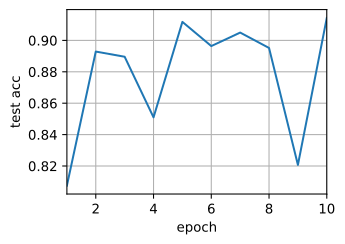
実際にどのように動作するか見てみよう。準備として、ネットワークを単一GPUで学習する。
train(net, num_gpus=1, batch_size=256, lr=0.1)
test acc: 0.91, 12.3 sec/epoch on [device(type='cuda', index=0)]
weight = net[0].params.get('weight')

try:
    weight.data()
except RuntimeError:
    print('not initialized on cpu')
weight.data(devices[0])[0], weight.data(devices[1])[0]
not initialized on cpu
(array([[[ 0.01382882, -0.01183044,  0.01417865],
         [-0.00319718,  0.00439528,  0.02562625],
         [-0.00835081,  0.01387452, -0.01035946]]], ctx=gpu(0)),
 array([[[ 0.01382882, -0.01183044,  0.01417865],
         [-0.00319718,  0.00439528,  0.02562625],
         [-0.00835081,  0.01387452, -0.01035946]]], ctx=gpu(1)))
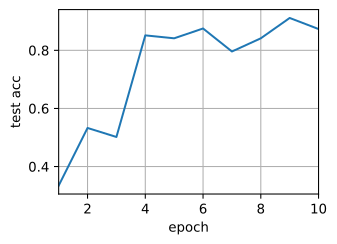
次に、学習に2つのGPUを使う。 13.5 章 で評価した LeNet と比べると、ResNet-18 のモデルはかなり複雑である。ここで並列化の利点が現れる。計算時間はパラメータ同期の時間よりも十分に大きくなる。これにより、並列化のオーバーヘッドの相対的な影響が小さくなるため、スケーラビリティが向上する。
train(net, num_gpus=2, batch_size=512, lr=0.2)
test acc: 0.87, 7.5 sec/epoch on [device(type='cuda', index=0), device(type='cuda', index=1)]
#@save
def evaluate_accuracy_gpus(net, data_iter, split_f=d2l.split_batch):
    """Compute the accuracy for a model on a dataset using multiple GPUs."""
    # デバイス一覧を問い合わせる
    devices = list(net.collect_params().values())[0].list_ctx()
    # 正解予測数、予測数
    metric = d2l.Accumulator(2)
    for features, labels in data_iter:
        X_shards, y_shards = split_f(features, labels, devices)
        # 並列で実行する
        pred_shards = [net(X_shard) for X_shard in X_shards]
        metric.add(sum(float(d2l.accuracy(pred_shard, y_shard)) for
                       pred_shard, y_shard in zip(
                           pred_shards, y_shards)), labels.size)
    return metric[0] / metric[1]
13.6.4. まとめ
データは、データが存在するデバイス上で自動的に評価される。
そのデバイス上のパラメータにアクセスしようとする前に、各デバイス上でネットワークを初期化するよう注意しようう。そうしないとエラーが発生する。
最適化アルゴリズムは、複数GPUにわたって自動的に集約する。
13.6.5. 演習
この節では ResNet-18 を使った。エポック数、バッチサイズ、学習率を変えてみよ。計算により多くのGPUを使ってみよう。16個のGPU(たとえば AWS p2.16xlarge インスタンス)で試すとどうなるか?
ときには、デバイスごとに計算能力が異なることがある。GPU と CPU を同時に使うこともできる。どのように仕事を分担すべきだろうか。その労力に見合う価値はあるだろうか。なぜであるか?なぜではないであるか?